
Most leaders didn’t get where they are by stepping back. They got there through their knowledge, production and ability to get things done. That identity and approach is hard to let go of, and in many cases, it becomes the very thing that limits how far they can go next.
The shift from doing to leading isn’t about working less or caring less. It’s about recognizing that at a certain point, your greatest contribution is no longer what you personally produce. It’s how effectively you develop your people, direct your area, and spend your time on the things only you can do.
That shift is harder than it sounds, and it doesn’t happen by accident.
Spend Your Time Strategically
The first obstacle is usually understanding what being “strategic” means. Many leaders assume that operating strategically means staying out of the details. This is not always the case. There are times when diving into the weeds is exactly the right move. The question is whether you’re doing it intentionally, to move something important forward, or whether you’re being pulled in by habit, pressure, or a desire to be helpful.
That desire to be helpful is worth examining closely. The leaders we work with consistently show up with high desire to be helpful, and it’s genuinely one of their strengths. But when helpfulness means absorbing problems your team should be solving, taking things off plates that need to stay full, or jumping in before someone has a real chance to figure it out, it quietly becomes a ceiling on your organization’s growth. High performers, in particular, notice when they’re not being given the opportunity to stretch.
The reframe here is to shift your personal measure of success away from outputs and toward inputs. Rather than evaluating your day by how much you got done, evaluate it by how you spent your time. Did you develop someone today? Did you move your strategy forward? Did you spend any time understanding what’s happening in your environment and connecting it to your business? Those are the questions that reflect what leadership actually requires.
Set Clear Expectations
One of the most consistent gaps we see in leaders who are trying to make this shift is feedback. According to Pew Research, 66% of employees don’t receive enough feedback from their managers, and the data is unambiguous: the more feedback people receive, the more satisfied they are with the amount they are receiving. Giving people a clear picture of where they stand is not optional if you want them to operate with confidence and autonomy.
The most common version of feedback leaders give is incomplete. Telling someone “good job” or “you need to show up on time” are both missing the piece that actually helps people grow: the impact. What did their behavior communicate to others? What does it make you, as their leader, perceive about them? That interpretation, paired with the observation, is what turns a comment into something a person can genuinely learn from.
To create clarity, you have to be clear. That means sharing your perspective, holding people accountable, and actively communicating, not because you’re being harsh, but because people cannot adjust to expectations they don’t fully understand. Delivering hard feedback is a difficult choice. It is also one of the more significant gifts a leader can give.
Empower Your Direct Reports
Empowerment is frequently confused with delegation, and that confusion creates real problems. Delegating work is not the same as handing off accountability. Leaders who make this shift are still responsible for outcomes, still need to know their business, and still lead through their people rather than around them.
A practical way to think about this is through the lens of decision-making authority. Not every decision needs to come to you, and not every decision should be made without you. The goal is to be explicit with your team about which is which, and then to calibrate continuously as their judgment develops. When someone brings you a decision that didn’t need your involvement, tell them. When someone makes a call that should have included you, use it as a coaching moment rather than a reason to tighten control. Over time, the number of decisions that require your input should shrink, not because you’ve let go of accountability, but because your team has grown into it.
You Are the Deliverable
The throughline in all of this is that the shift from doing to leading is fundamentally a personal one. The tools, the frameworks, the restructured calendar, those things help. But none of them matter much without an honest look at what choices you are making about your time, your team, and your own development.
Leadership at this level takes practice. You will not get it right immediately, and that is expected. What matters is whether you are making the hard choices consistently enough to build new habits, and whether you are holding yourself to the same standard of growth you hold your team to.
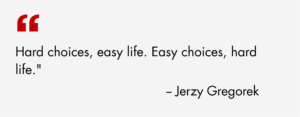
Hard choices lead to an easier path forward. The easy choice, every time, leads somewhere harder.